Music Piano: Magic EDM
- 4.6
- Rating
- 5.00M
- Installs
- Free
- Price

 Analysis by App-foxy
Music Piano: Magic EDM is the kind of mobile game that makes a strong first impression because it asks for almost no preparation. I tap the notes as they arrive, follow the beat, and quickly get that satisfying feeling of keeping a song alive. After spending time with it, I found that its real question is not whether it is enjoyable for a few minutes—it is whether the simple rhythm loop can remain interesting once the novelty wears off.
My short answer is that it works best as a quick, energetic music game rather than a replacement for a full piano-learning app or a deep rhythm game. It is free to start, belongs to the music-game category, and is made by Ding-Dong Games. The mature rating is important because this is not a title I would casually hand to a child without checking the store classification first.
What the first week feels like
During my first sessions, the appeal was immediate. The basic interaction is easy to understand: watch the play area, react to the notes, and try to stay accurate while the electronic music pushes the pace forward. I did not need a tutorial-heavy introduction to understand what the game wanted from me. That simplicity makes it a convenient choice when I have only a few spare minutes.
You May Also Like

 Google Keep - Notes and lists
Google Keep’s Quiet Growth Shows the Appeal of Simpler Notes
As mobile work gets busier, Google Keep keeps winning a simple contest: capture a thought quickly, find it later, and get on with the day.

 Blood Strike: 2.5 Anniversary
Blood Strike’s Loadouts Turn Every Drop Into a Tactical Gamble
A close look at Blood Strike’s custom loadouts: how fast access to signature weapons reshapes its battle royale rhythm, rewards preparation, and narrows the gap between fights.

 Pandora - Music & Podcasts
Pandora’s Music Is Easy to Start, but Harder to Recover
Pandora’s strength is its low-effort path from a seed to a station. Its weak spot is how much confidence it asks you to place in connection, setup, and quiet recovery.

 8 Ball Pool
 Is Built on Rivalries, Rematches, and Routine
A close look at the rivalries, rematches, shared routines, and unanswered safety questions that turn a quick pool match into a persistent mobile community.

 Samsung Music
’s Quiet Strength Is Playing What You Already Own
Its reach comes less from spectacle than from dependable access to a personal library. That simplicity is both the app’s strongest retention engine and its ceiling.

 AccuWeather: Weather Radar
AccuWeather Review: A Quick, Clear Forecast for Everyday Decisions
For everyday plans, the best forecast is the one you can understand quickly. AccuWeather makes rain timing, radar, and local conditions easy to act on, with a few trade-offs.
More From Our News Desk



The best time to play is when I want a small burst of concentration. A short session can fill the gap before an appointment, give me a break between tasks, or provide something more active than scrolling through social media. The game does not demand the long commitment of a traditional music title, and that low entry barrier is one of its clearest strengths.
There is also a useful physical rhythm to the experience. I am not simply listening to EDM in the background; I am responding to it. When my timing is good, the music and taps feel connected, which gives the game more energy than a passive playlist. When I miss repeatedly, the same connection works against me because the pressure becomes noticeable very quickly.
I would not describe the opening experience as piano practice in the educational sense. The on-screen interaction may resemble playing keys, but the goal is performance inside the game, not learning scales, reading sheet music, or developing proper finger technique. That distinction matters if you are considering it for someone who wants a serious introduction to an instrument.
Why the simple format works
The straightforward design is particularly effective on a phone. I can pick it up with one hand, start a session, and focus on the moving notes without studying a complicated interface. That makes it more approachable than rhythm games that introduce several controls, characters, upgrade systems, or story screens before the music begins.
It also gives the game a clear identity. Music Piano: Magic EDM is not trying to simulate a real keyboard in a detailed way. It turns piano-like tapping into an arcade challenge built around electronic music. I think that is a better way to approach it: judge it by its timing, flow, and replay impulse, not by whether it teaches me to play a physical piano.
A practical tip helped me enjoy the early sessions more: I stopped trying to play every song at maximum speed immediately. I first concentrated on recognizing the visual rhythm and keeping a steady hand. Once that felt comfortable, I could focus on accuracy instead of reacting in a panic. This small change made the game feel less like random tapping and more like a skill I could gradually improve.
Who will enjoy the opening most
The first-week appeal is strongest for players who already enjoy rhythm games, electronic music, and quick score-based challenges. It is also a reasonable pick for someone who wants a casual game with a musical theme but does not want to learn a complex control system.
Players who need a strong narrative, exploration, or a large strategic layer may find the experience thin. The same is true for musicians looking for a practice tool. I would choose a dedicated piano-learning application for lessons and feedback on real technique, while I would choose a more elaborate rhythm game for deeper progression and variety. This title sits comfortably between those options as a focused, accessible tapping game.
The store page shows an average rating of 4.6 from around 27 thousand ratings, and the game has passed 5 million installs. Those figures suggest that the core idea has found a sizeable audience, but they do not change my main advice: popularity is not a substitute for matching the game to your preferred kind of play. If you dislike repeating timing challenges, a large player base will not make the loop feel deeper to you.
What remains after the novelty fades
The month-to-month value depends on whether I enjoy chasing improvement. The central interaction is intentionally narrow, so long-term interest comes from refining timing, replaying music, and trying to perform more consistently. I can return for a quick challenge, but I should not expect the game to transform into a different genre after several weeks.
That can be a positive thing. Some mobile games become cluttered with systems that distract from their original idea. Here, the musical tap challenge remains the reason to open the app. If I want a dependable five-minute activity, that consistency is useful. I know what kind of concentration it will ask from me, and I do not have to rebuild a complicated strategy every time I return.
The trade-off is that the same consistency can become repetition. Once I understand the timing pattern and settle into the visual rhythm, the excitement depends heavily on how much I care about improving. Players who naturally replay levels to clean up mistakes may find a lasting routine. Players who need constant new mechanics may feel that the game has given them everything important during the first week.
Building a sustainable play habit
I found that shorter, deliberate sessions are better than trying to grind for a long stretch. Playing until my reactions became tired did not make me better; it mostly made small mistakes more frustrating. A useful routine is to play a few attempts, notice whether misses happen because of speed or distraction, and then stop before the session turns into automatic tapping.
This is also where the game can fit into everyday life. Imagine waiting for a bus with enough time for only one or two attempts. The game gives that pause a clear beginning and end. I can also use it as a mental reset after work: the need to watch and react pulls my attention away from unfinished tasks. It is not relaxing in the same way as a quiet puzzle, but it can be refreshing when I want active focus.
Another practical approach is to treat difficult sections as timing exercises rather than failures. If I rush because the music feels intense, I lose the rhythm before the game becomes genuinely challenging. Keeping my hands relaxed and watching the note path slightly ahead of the next tap helps more than simply tapping harder or faster. That is a small but meaningful lesson for anyone who wants to improve without turning casual play into a chore.
Free access and the cost of continuing
The game is free to download, which makes trying it straightforward. It also includes in-app purchases ranging from $0.99 to $5.99 per item. I would keep that in mind before settling into a daily habit, especially if the game becomes part of a routine where repeated optional purchases start to feel normal.
My advice is to decide in advance what role the game has on your phone. If it is an occasional time-filler, the free starting point may be enough for you. If you are highly competitive and feel pressure to obtain every available convenience, the purchase range becomes more relevant. I would not install it with the assumption that spending is necessary, but I would still use the device’s purchase controls if someone else, particularly a younger family member, might play on the same account.
The first release was on October 11, 2023, and the current version is 1.102.0. That continuing version history is reassuring for a game that relies on returning players, although it does not automatically guarantee that every future session will feel fresh. I still judge the app by the quality of the core loop: if I am enjoying the timing challenge, updates are a bonus; if I am already bored, a new version number alone will not solve that.
Where fatigue starts to appear
The main source of fatigue is repetition in the input. Tapping notes to music is satisfying when my attention is sharp, but it can become mechanical when I play for too long. The game’s strongest feature is therefore also its biggest limitation. It has a clear focus, yet that focus leaves less room for variety than I would find in a full rhythm-game package.
Visual concentration can become tiring as well. I need to keep my eyes on the play area and react at the right moment, so this is not an ideal game for playing while walking, watching television, or dividing attention between several tasks. Even a simple rhythm game deserves a stable posture and a clear screen. When I tried to play distractedly, the misses felt less like a challenge and more like a consequence of poor conditions.
Electronic music will also determine how long the game stays installed. If EDM is already part of my listening habits, the theme supports repeated sessions. If I prefer acoustic, orchestral, or relaxed music, the sound may limit the game’s appeal before the mechanics do. This is not an issue that can be fixed by better strategy; it is a matter of whether the musical identity suits me.
The mature 17+ content rating is another reason I would not treat it as a universal family game. A rating does not tell me how every moment will feel personally, but it is enough to make me check the intended audience before recommending it to a teenager or younger player. For adults who enjoy music games, the rating is simply part of deciding whether the title belongs on a shared device.
Maintenance without turning play into homework
Keeping a casual game installed only makes sense when returning to it remains easy. I would avoid creating a rigid daily obligation around this one. The moment I feel that I must maintain a streak or force myself through sessions, its quick-play advantage disappears. It works better as a game I revisit when I want focused tapping, not as a task I have to complete.
Storage and attention are also forms of maintenance. Every app competes for space on a phone and for a place in my routine. Because this game has a narrow purpose, I would ask myself whether I actually use it for that purpose. If I open it only once every few months, a dedicated rhythm game with broader variety—or simply a music app—may deserve that space more.
I would also keep expectations realistic about progress. The game can sharpen my familiarity with its own timing challenges, but I would not use improved scores as evidence that I am learning piano. That is a subtle trade-off: it can make me feel musically engaged without providing the structured, transferable instruction that a learner needs. Knowing that prevents disappointment and helps me enjoy the title on its own terms.
My long-term verdict
After the first burst of excitement has passed, Music Piano: Magic EDM earns lasting space only for a specific kind of player: someone who likes short EDM rhythm challenges and is happy to return to a familiar interaction for the sake of better timing. For that audience, its free entry, simple controls, and quick sessions make it easy to keep available.
I would recommend it to a friend who wants an uncomplicated music game for breaks, commutes when safely stationary, or short evening sessions. I would explain that the fun comes from reacting accurately and repeating attempts, not from building a virtual piano career. I would also mention the mature rating and the optional purchase range before they install it on a shared device.
I would skip it if I wanted piano lessons, a broad instrument simulator, a story-driven game, or a rhythm title with a constantly changing set of mechanics. Those needs point toward different alternatives. This game is at its best when I want a clean, focused challenge rather than a complete musical ecosystem.
My final recommendation is conditional but positive: try it if the combination of piano-style tapping and EDM sounds appealing, then judge it after several separate sessions rather than one exciting first play. If I still enjoy improving my timing after the novelty fades, it has a useful place in my casual-game rotation. If the repeated pattern already feels tiring, uninstalling it is reasonable; the game’s simplicity is a strength only when that simplicity matches the way I like to play.
FAQs for Music Piano: Magic EDM
01What is Music Piano: Magic EDM, and how is the gameplay structured?
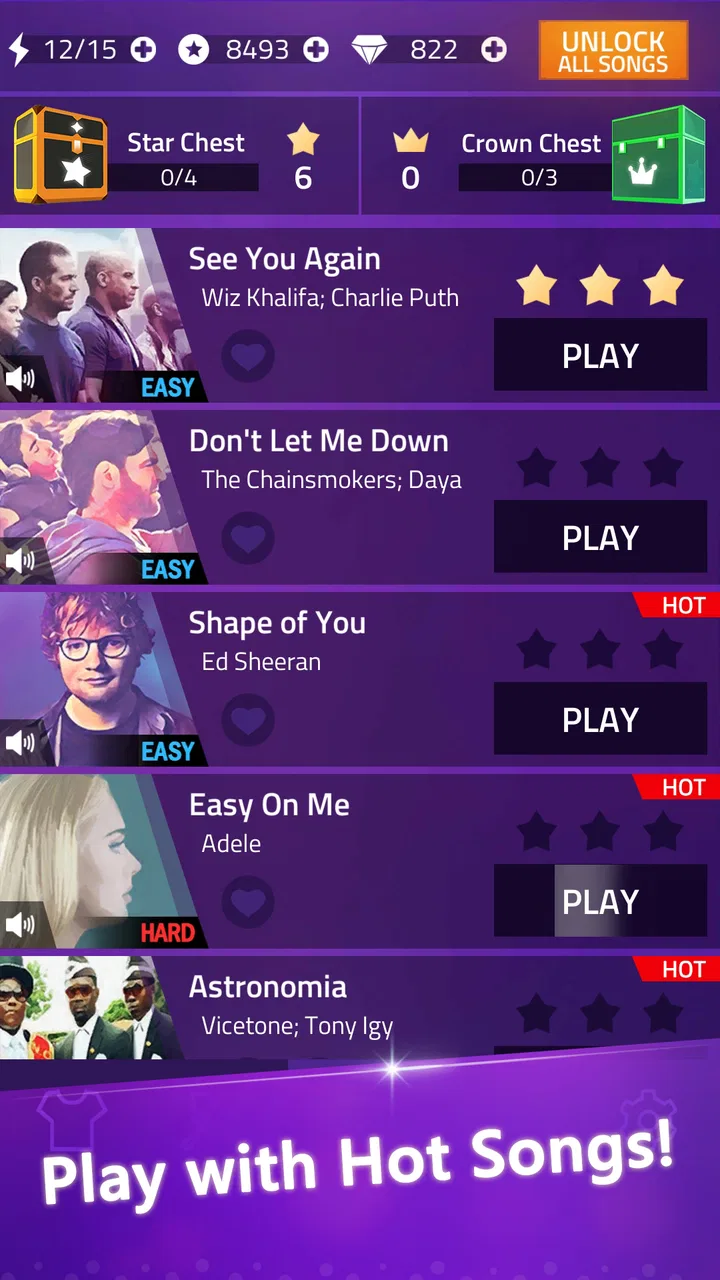
Music Piano: Magic EDM is a rhythm game in which you tap piano-style tiles in time with electronic dance music. Notes usually move toward a target area, and your goal is to touch the correct tiles without missing them. Successful taps build your score and combo, while missed notes can interrupt your progress. The game is designed for short, fast-paced sessions and uses increasingly challenging songs and patterns.
02Does Music Piano: Magic EDM require an internet connection to play?
The basic gameplay may work without a constant connection once the necessary songs and game resources have been loaded, which is useful when traveling or playing with limited data. However, certain features can depend on internet access, including advertisements, online rewards, new content, account synchronization, or leaderboard functions. Availability can also vary by version and device, so it is best to open the game online first and check which songs are accessible offline.
03Is Music Piano: Magic EDM free to download and play?
Music Piano: Magic EDM is generally offered as a free download, allowing users to try the main rhythm gameplay without paying upfront. Like many free mobile games, it may include advertisements, optional purchases, or paid benefits connected with extra content, lives, bonuses, or ad removal. Before downloading, review the store listing and in-app purchase information, especially if children may use the device, because costs and available purchase options can change.
04What permissions, advertisements, or privacy concerns should users consider?
Before installing Music Piano: Magic EDM, users should review the permissions shown on the Google Play Store or App Store and compare them with the game’s features. A rhythm game normally should not need access to sensitive information unrelated to gameplay. Free versions may display banner, interstitial, or rewarded advertisements, and advertising or analytics services may collect technical usage data. Check the developer’s current privacy policy for details about data handling.
05Is Music Piano: Magic EDM suitable for beginners and children?
The game is generally easy to understand because its main control is simple tapping, making it approachable for beginners. Nevertheless, later songs may require quick reactions, accurate timing, and repeated practice, so younger players may find the difficulty demanding. Parents should also consider advertising, optional purchases, music volume, and screen-time limits. Using headphones at a moderate volume and enabling device purchase restrictions can make the experience more suitable for children.
Pros
- Simple controls make it easy for beginners to start playing.
- Fast-paced songs provide an engaging challenge for rhythm-game fans.
- Bright visuals and effects make performances feel energetic.
- Song progression gives players a reason to keep practicing.
- Works well for short gaming sessions on mobile devices.
Cons
- Some tracks or features may require in-app purchases to unlock.
- Frequent visual effects can feel overwhelming during difficult songs.
- Timing accuracy may be affected on older or less responsive devices.
- The game can become repetitive after extended play sessions.
- Ads may interrupt gameplay or appear between song attempts.

Music Piano: Magic EDM
Gallery